An Interview With Tai Chi Master Yon Lee – Part One
June 2016This is part one of several parts of a comprehensive interview with Master Lee. Want to learn more about tai chi? Come practice with us in Harvard Yard!
We hurried amidst the bustle of college students and throngs of tourists snapping pictures on smartphones, while avoiding cars and bicycles disobeying the crosswalks to make it just in time for our 4pm interview. We speedwalked around the corner and down Plympton Street, until we arrived at a secret garden amidst the chaos of Harvard Square.
Sitting in a hammock amongst green leafy trees, chirping birds, and the historic brick undergraduate residence was a gentleman in his sixties, wearing a baseball hat shading salt and pepper hair and a calm smiling face. This is Master Yon Lee. “It’s a jungle out there,” he says.
In this elusive enclave of Adams House courtyard, we have had the opportunity to practice tai chi under the patient guidance of Master Yon Lee for several years. Tai chi is an ancient Chinese martial art, a slow meditative dance of circular motion, practiced widely for its stress reduction and health benefits. Like this beautiful courtyard, and the practice of tai chi itself, Master Yon Lee is a hidden gem with a very powerful calming and healing presence. Though you may not have heard of him, Master Yon Lee has also been very influential in the Boston community for the past fifty years.
I met Master Lee several years ago in Harvard Yard, where he leads free tai chi classes, on Tuesdays and Thursdays at 5pm. I saw a group of people moving slowly and gracefully on the lawn under the trees. “Come join us.” Master Lee said. After a long day of work sitting behind a computer, I found myself transformed following Master Lee’s slow, fluid tai chi movements in the fresh air. Practicing with a small group of community members, I knew I had discovered something rare and special. I admired Master Lee’s knowledge of tai chi and its philosophy, and his commitment to share this practice with anyone interested in learning. Sometimes he would grab the arm of an unsuspecting student and demonstrate the martial arts application of the tai chi practice we were learning. Other times, he would ask us to imagine doing tai chi in a wall of mirrors, or to move by following our shadow. In class we would often get a taste of the deep complexity of his wisdom and his sense of humor. However, today Karootza Magazine would have the opportunity to learn even more about his story and how he discovered tai chi. This is part one of several parts of a comprehensive interview with Master Lee. Want to learn more about tai chi? Come practice with us in Harvard Yard!
Karootza: “Maybe we could start from the beginning, from your childhood. Where did you grow up?”
Master Lee: “I grew up in Boston actually. I left China when I was eight and I came here when I was ten, and I’ve been here ever since.”
Karootza: “Do you remember the early days in China, when you were born?”
Master Lee: “There are some good memories, like, when we were kids, we would just wander all over the place, absolutely no supervision. We grew up on a farm. I do remember the water buffalo chasing after me. ”
Karootza: “When you said I grew up on a farm, I was thinking about chickens.”
Master Lee: “No. It was a rice paddy, with water buffaloes. There were chickens in the courtyard. That much I remember. I used to get fresh eggs. You can’t get any fresher than that. When a hen had a fresh egg, I would go over there and fetch it before anyone else. But that’s not tai chi anyway.”
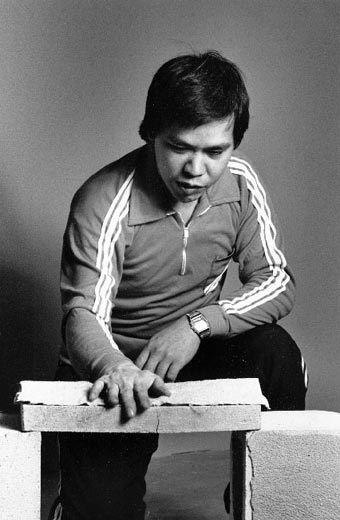
Master Lee breaking a brick with his hand
Karootza: “When was your first experience with tai chi and kung fu?”
Master Lee: “I was attending classes at the Chinese University in Hong Kong, doing my senior year abroad. It was in 1971. There were so few teachers in the Boston area or anywhere in the US. You have to go to China to find them. So I went all the way to Hong Kong. China wasn’t open to foreigners yet. The person teaching it was from UC Berkeley. Interesting enough, she was one of the lecturers for foreign students, to get them acclimated. She came over and tapped me on the shoulder. She said, “I just wanted you to know that I’m tapping you on the shoulder.” Just a gentle tap, but a lot of pain afterwards. That was my first introduction to tai chi.”
Karootza: “A gentle tap?”
Master Lee: “Just a gentle tap on the shoulder, but very painful afterwards. The next morning we started classes on the playing fields. Since then, it’s been history. It was around the same time Bruce Lee went to China to promote his films. And then became the craze that opened up the whole gate of people interested in Chinese culture to martial arts. Those couple of decades more than anything else promoted Chinese culture, arts.”
Karootza: “Did you know about Bruce Lee when that person tapped you on the shoulder?”
Master Lee: “No, at that time I’d never heard of him. Wherever I go in Hong Kong, people would say, “You’re from America, so you must know Bruce Lee.””
Karootza: “Even though you shared the same last name?”
Master Lee: “Even though his movie was in the box office records, I never went to see it until a few months before I left Hong Kong to come back to the States. It was that popular, but not to the people stateside. The establishment at that time was not really for Bruce Lee. They would still look at him as an outsider from the States. He got a good reception from the general public. He did not get a good perception from the professional community. Even after his death, for a while he was still considered an outsider. It wasn’t until a later generation he proved more popular.”
Karootza: “I grew up watching his movies, Enter the Dragon, Fist of Fury, the mirrors scene…”
Master Lee: “When that movie came out, Enter the Dragon, he was already dead. And the studios had to send out the presentation without him going to different places to promote it. So each city was on their own to figure out what they were going to do. So, locally here in Boston, they contacted me. I don’t know why they contacted me, but I’m glad they did. And at that time, I wasn’t really that interested, but they said not only are we going to provide you with good publicity, but you can watch any movies that our theatre is making anywhere in the city, unlimited seating and so forth, so I said, I’ll take it.”
Karootza: “Were you by then well into your practice of kung fu?”
Master Lee: “I was teaching it. That’s how they found me. I was one of the few teachers who was willing to teach non-Asians. Because at that time in Boston, and at a lot of the schools in the US, they would not openly enroll non-Chinese students.”
Karootza: “Did you get more students once you started promoting Bruce Lee?”
Master Lee: “Not only I got more students. I got stopped in the middle of the street, “You look like Bruce Lee!”
Karootza: “Did you ever get a chance to meet Bruce Lee?”
Master Lee: “No, he was dead already.”
Karootza: “What did you start first, tai chi or kung fu? Do you start with tai chi or kung fu? How does it work?”
Master Lee: “It’s a combination of both. My first formal training was more kung fu than tai chi. The other thing is that people say, “Why do you choose one over another?” It’s not that you choose, it’s what’s available. And who’s willing to take you under their wing. And at that time at the university, it was offered free to university students.”
Karootza: “Was there a good master to take you under their wing?”
Master Lee: “Well, she was more a coach than considered a master. I was already taking some training with a local master in Hong Kong, that friends recommended to me when I was there.”
Karootza: “Do you remember the first kung fu practice/training?”
Master Lee: “Probably the most memorable part was, it was not difficult to do, but it was very painful the next morning. Some of the things require that you get in a position and hold it for seemingly hours, though it was a few minutes. But a few minutes at that time felt like hours. The next morning it felt like days, how strenuous it was, even for a young fellow doing it in my university years.”
Karootza: “Did you go back the next day for training?”
Master Lee: “Unfortunately, yes.”
Karootza: “Why?”
Master Lee: “Because when you’re that young, you don’t want to think there’s anything you can’t do physically.”
Karootza: “Interesting. How old were you then?”
Master Lee: “In my early 20s.”
Karootza: “You did it in Hong Kong. Then you came back home. What did you do when you came back home? Did you come back to Boston? Did you find another place to practice?
Master Lee: “Different places working with different groups.”
Karootza: “Did you find a good master here to practice with?”
Master Lee: “There were a lot of them. I was with two different groups, so I was able to work out with them.”
Karootza: “What were they saying when you started teaching non-Asians? Because at the time, you said they weren’t teaching non-Asians.”
Master Lee: “Well, I remember the very first black students I accepted. And everybody when I went down to the coffee shop, they were all looking at me like, sending hostilities, until one of them sort of broke the ice, and said, “We heard that you just accepted a black student.” I said, “Yes I did.” “Do you think that’s a good idea?” I said, “Why?” “Do you know what kind of person he is?” “Yes, he’s a dentist. He’s a professional.” “Oh, okay.” Like a dentist is better than not a dentist or something.”
Karootza: “Did you go to China at any time to practice? I grew up with those Chinese movies, Jackie Chan, Bruce Lee, and all the time you see these monasteries where they practice and pray and the tigers.”
Master Lee: “Back in the 70s, China was still closed to non-Chinese. Even though I was born in China, holding an American passport, I was still considered a foreigner. So, being next to China, in the gateway to China in Hong Kong, afforded me the opportunity when - before Nixon went in, after Kissinger did his famous meeting in Beijing - they allowed me to go into one city, Puchong (not sure of the spelling of this). And they wouldn’t allow me to go anywhere else in China. It was highly controlled. And limited. And one of the excuses was that Nixon was visiting, they were preparing for Nixon’s visit, and therefore not only were foreigners not allowed to go into China. Beijing and Shanghai were told to relocate down to Huangzhou, so that they could prepare for Nixon’s visit. It was a huge thing. So that was in January/February, my first visit back to China. Then in May, after the visit, I applied and was granted a visa to go all the way up to Beijing. Every place was pretty much closed. We wanted to visit universities. They let us take a tour of Tsinghua, which is the equivalent of MIT in China. And one of the first places they took us on the tour was the library. I go in the library, and I see lots of books. But no people, no students. And I went by to look at a copy of Popular Science. And I do this (makes wiping gesture on table with finger); there’s dust all over it.”
Karootza: “Did you get to talk to people during your visit?”
Master Lee: “One of my memorable visits, was the hospital where there were demonstrations of acupuncture and so forth. They gave a talk, the person giving the introduction spoke perfect English, must have been training in England or the US, and he gave us a couple of explanations on why/how acupuncture works. That’s when I got extremely interested in Chinese medicine and the concept of chi theory and meridian and channels.”
Karootza: “Is this how you transitioned to the tai chi part?”
Master Lee: “A little. Officially they weren’t tying them together. It just took a while to slowly get introduced to other people. Chi kung masters in China and elsewhere at that time were very close knit.”
Karootza: “Did it open up meanwhile?”
Master Lee: “It wasn’t really opened up until much later in the 70s.”
Karootza: “Coming back to Boston, did you open a school?”
Master Lee: “With some associates, we went into a partnership, with a few masters. Instead of teaching only one system, I thought maybe we could combine a place where many masters and teachers would be offering. So people could get a selection, all at one price. It was popular particularly among non-Chinese. Because the Chinese still believe in following only one system, and one teacher. A lot of teachers like to maintain that their system is the best; they won’t allow students to go and study with others. I find that not only archaic, but non productive. You need to compare.”
Karootza: “I relate that to karate. So, you turned from the student that got tapped on the shoulder, felt a pain the next day, going to the training, being sore for a day after his first training, to opening a school in Boston, challenging the system entirely, teaching different styles, offering to non-Chinese people. What was the journey? How did you decide you were going to do all this stuff? Because you didn’t major in…”
Master Lee: “I majored in Nuclear Physics.”
Karootza: “So that’s what I’m saying, someone majoring in Nuclear Physics going and doing all this transformation. How?”
Master Lee: “Well, it was at a point where physics in America at the time, was… During the height of the Vietnam draft/conflict, there was a university, particularly students and liberal administrators and teachers who were really politically active against the war. The administration at the time decided to… One of the very dark conflicts was after Nixon was elected the second time. Massachusetts was the only one that did not vote for him. The following year, he cut off a lot of the research grants to many of the defense contractors, and a lot of other things. Many of the scientific labs and companies along 128, including technology square in Cambridge, went literally from a boomtown to a ghost town. And so, a lot of jobs are not opening; a lot of jobs are lost. Not only those who used to have jobs, but the new crop of students, including newly minted PhDs were relegated to pumping gas. And it was like that for many years. So, from the time I was going to graduate school, a lot of advisors were saying, we don’t know what prospects will be like yet. If your classmates with a PhD are relegated to pumping gas – this may not be quite the future you want. Also the frontier of physics was coming to a bottleneck. There aren’t that many great new discoveries, if any discoveries at all. So, with China coming up in the field, it was a suggestion that I ought to go and visit China and learn what they were doing, and see if I can take that knowledge and come back and share it.”
Karootza: “So, they asked you to be a spy?”
Master Lee: “No. Not necessarily a spy. Academically, inquisitive. So, by the time I get over there, the class I signed up for at the university over there was taught by a professor who graduated from my college. He’s using the same lecture notes from the class I took here in the States, same book. So, here I am traveling 12,000 miles, all the way to Hong Kong, to go into China. He looked at me, “Everything’s the same. I’m using the same notes we used last year”. It was kind of a going there, literally finding the great wall, like a firewall. So you can’t learn anything new about physics, but there’s a lot of new stuff. Arts. Calligraphy. So I started taking the other things not academically available in the States. After having traveled all over China for a week or so, I came back. I was very popular, invited to give talks, and show my movies. Back then, you don’t even get any footage on television. So, I found I was an ambassador of Chinese culture. And before you know it, it became such a natural thing. And then the movies came out, and I was more pushed, drawn into the circle. Almost a celebrity. You look back, it’s kind of fun.”
Karootza: “Did you get to use your nuclear physics degree?”
Master Lee: “Well, my understanding, my interpretation of tai chi, Chinese medicine and chi kung. If anyone paid attention or listened, I sprinkle them with analysis of using quantum mechanics.”
“There’s a party?” Yon yells to man bringing food into Adams House. “In there? When?”
“For students.” The man responds.
“Well, I’m a student.” Yon says.
Kathleen is passionate about food, travel, wellbeing and helping people create meaningful livelihoods.
Nicu is passionate about food, travel, wine, entrepreneurship and about helping people reach their potential.