My unexpected journey: from Iaşi, Romania to Boston, MA
via Neuchatel (Switzerland), Vancouver (BC), Ithaca (NY), Malvern (PA), and Nuremberg (Germany)
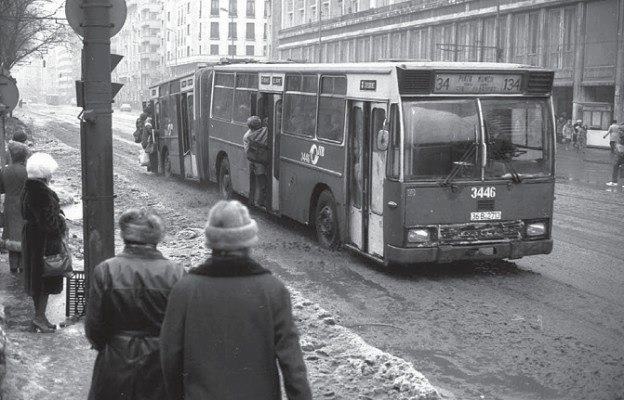
June 2016For years, I meant to write about my long - long and unexpected journey. From growing up in Iaşi in the communist Romania (or as the country was called at the time Socialist Republic of Romania), going through a PhD program in Switzerland, moving to Vancouver (British Columbia, Canada) for a postdoc, arriving in Boston for a faculty role, joining an MBA program in Ithaca (NY), returning to Boston, living temporarily in Malvern (PA), then working temporarily in Erlangen (Germany) and finally returning to Boston where I happily live and consider my home.
I am grateful to Karootza Magazine for providing me the platform and encouragement to finally write. I look forward to engaging with YOU, the readers in the upcoming issues. Please do provide feedback, comments, questions, topics that you want me to provide more insights on. I will do my best to consider your comments in the next issues.
So let’s start with the beginning.
Born in a communist country
We don’t get to choose where we are born, but we have to make most of it. I was born in Iaşi, in the Socialist Republic of Romania. Obviously, I wasn’t aware at the time my “fortune” of being born in a communist country, but going to school I was reminded weekly how lucky I should feel for being protected by the communist government, and not being the “slave” of a capitalist society.
There was a bivalent life.
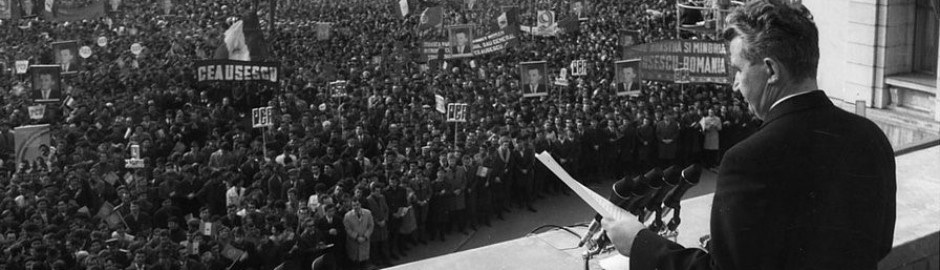
In public, at school, in society, on TV, in the newspapers – everywhere, there was communist propaganda. For instance, there were poems about how wonderful the president is – the bravest, the smartest, the most beloved son of the country. It’s hard to explain it – but imagine Brad Pitt or Dustin Hoffman on NBC at 8pm reciting a poem praising the President. Something like this one, from that Romanian era:
“His clear mind is protecting us
As a wise and fearless man,
Young heart and waken mind,
In whom the entire country is reflecting.
He’s the Man – Ceausescu Nicolae -
Loved like our tri-color flag,
Like the red flag, clearly waving,
In the free flight towards the future.”
And here is the original in Romanian, I translated as best as I could:
Şi-n fruntea lui cea limpede veghează
Un înţelept şi ne-nfricat bărbat,
Inimă tânără şi minte trează,
În care ţara-ntreagă s-a-ntrupat.
E Omul - Ceauşescu Nicolae -
Iubit ca steagul nostru tricolor,
Ca steagul roşu, limpede văpaie,
În zborul liber către viitor.
At home, my parents told me to not take it seriously, be careful what I say and to whom – in those days, the secret police could arrest you for just saying anything that was even perceived being against the communism.
At the same time, there were shortages of any single possible kind. Imagine you go to Whole Foods and the shelves are empty except a few cans of tuna fish and a few cans of tomatoes. Imagine going to Macy’s and there are no shoes, no clothes. Imaging that to buy a car, you have to submit an application, that you pay half of the cost, and then you wait 7 years to get it. Imagine that you complete college and you are assigned a job, and you don’t have any say about it and you can’t change it.
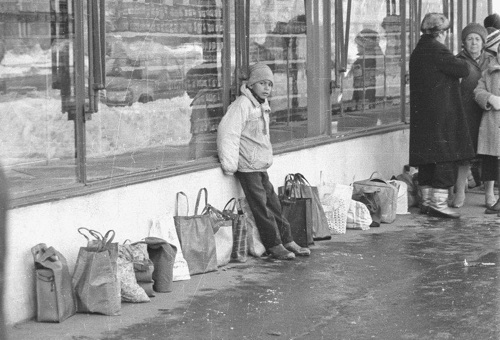
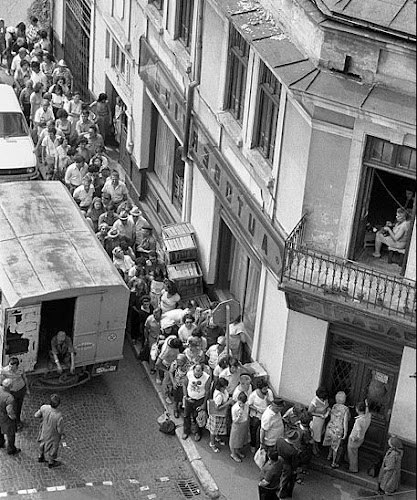
Imagine long lines of people waiting for food (any kind of food) to be delivered daily to the store. Imagine people who join a line without knowing what the line is for – but for the idea that at the end of the line there is something you can buy. Imagine 2 weeks wait in line on a list to buy “Amigo”, a kind of Brazilian instant coffee.
Imagine 2 hours of TV program a day, where you could only hear official propaganda – how great the situation is and hear poems like the one above.
Well, now that you imagined all these, imagine me being born that place; and my “fortune”.
That’s why I’ll be always grateful to Ronald Reagan for winning the cold war and saving me from that “fortune”. That is why, I’m fortunate to have become an American and have been welcomed by America, that I call now my country.
But let’s get back to me in that time in that place.
It’s hard to tell everything at once; but here are several stories, so you can understand me at that time.
Story 1: Buying salami “Victoria”
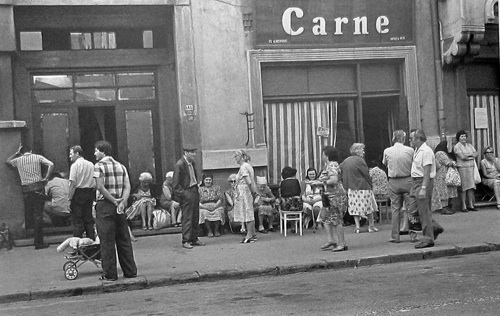
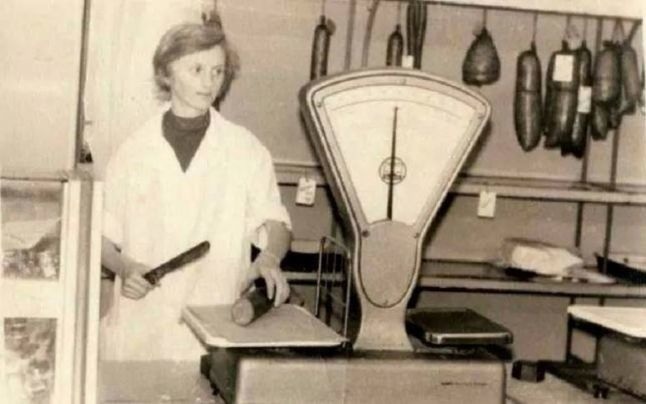
In general, Romanians tend to love meat. I think that in general, we tend to like things in short supply (think diamonds ☺). Meat was like diamonds in the communist Romania. For some reason, salami was an obsession for many, in particular a brand called “Victoria”. It was this tasteless combination of fatty meat parts, lots of soy protein and water, with an unappealing pinky color. I loved it though! So once in a while, my task when I was 11-12 was to “hunt” the Victoria salami. Here is how the “hunt” would go during my summer vacation when I was off school.
I would wake up in the morning, then I would go to a sort of grocery store that was called “Alimentara” – a alimenta in Romanian means to supply. I guess the communist government saw the need to supply people with food ☺.
Obviously, there was no food in the “Alimentara” in the meat section, except for several pork feet (only bone) displayed. Nobody will buy them, so I suspect they were either made out of plastic or they were in display for months.
You would walk in, and the people working in the store would ask you: “What do you want?”, as if you had a choice.
I would typically say: “Is there a food delivery today? When is the truck coming?”.
The answer was typically, “In the afternoon, maybe”.
In communist Romania that was considered being good news. I guess that’s why I have my optimistic nature. So, along with other kids and several
retirees we were standing in front of the door of “Alimentara” and waiting. Once, I remembered a few kids asked me to play cards with them.
But most of the time, I would just stand there and wait.
In a lucky day, the food truck would come in the afternoon. It would go in the back of the store to unload the salami and other meats that were in our dreams.
As soon as the truck would come, the crowd would get into an organized “chaos” mode. Other than everyone’s desire to eat the salami, there was an additional reason: everything was rationed. So for instance, they would only sell several slices of salami per person. So more people from the same household in line, more salami you’ll get. Hence, as soon as the food truck arrived, there was a rumor going in the area without Snapchat, Twitter nor Facebook (remember this was 80ies): the food truck arrived. Everyone at home who knew that their kid is waiting since early morning (like it was my case), would run quickly to the store, so they can also buy their fare share of salami.
Luckily, in my case, my father was working 5 minutes away from the store, and he would just see the food truck arriving. So he would join quickly. In the event he wouldn’t see it, I would ask someone in line to keep my spot in line, and would run to bring over my father (and mother if she wasn’t at work). Then, we’ll make our way into the crowd to the spot that I saved the entire day. There wasn’t actually a real line, but mostly a large crowd of people in front of the “Alimentara” door. For a neutral observer this could look like a complete chaos. In our minds, it was not.
As soon as the truck was unloaded, you could see several salami rolls, several pounds of sausages and several pounds of lard in display. The smoked (mostly) lard had a fancy German name – “kaizer”, while the sausages were called “cremvusti”.
Next, you’ll see the first people coming out with their joyful faces and salami in their hands – they would announce – it’s 250 grams of salami (a few slices) per person. Immediately, people in back of the crowd with little chances of getting anything, would start screaming: “Give less per person. We want some salami too!!!”.
I recall an instance, when I was with both my parents and we made it to buy our “Victoria” salami. It was at the end of a very frustrating long wait, and my father who otherwise was careful with his choice of words in public said: “Great success! We should thank Uncle Nicolae for this” (Nicolae Ceausescu was the head of the communist party and the guy who was putting everyone through this “diet”).
For saying something like this in public you could be arrested and put in prison without a trial. Unfortunately, at the same time, in the same store there was one of the guys working for the secret police, who happened to live in the same area, and who happened to like “Victoria” salami.
My father realized it quickly, and he started saying things like: “Indeed, the salami is really good, I like Victoria salami, and so are the sausages “cremvusti”, and look at the lard “kaizer” how delicious is. We should be grateful for all this”.
Immediately he grabbed my hand, and we walked out the door. I think it was the first time, when I was holding his hand, and not him mine. The secret police guy followed us, looking worried for a while, and at some point he looked around and just gave up. We understand that the guy was also afraid that someone might have reported him for not taking action, and he wanted to make sure he’s not getting himself in trouble. It was already 1989 by then, and the other communist regimes were falling – I suspect that the guy realized that there is no point to fight for the system.
So again, thank you Mr. President Reagan for tearing down the wall!
Story 2: Getting school textbooks
In communist Romania, it was a challenge to buy anything. Including textbooks. You needed to have connections at the printing house to be able to buy new ones. Otherwise, you’re out of chance and you’ll get textbooks that were re-used by generations and generations of kids before you. There was an entire process for it – at the beginning of the academic year you’ll get the textbooks wrapped in some kind of blue paper (very similar to the toilet paper from CVS); they were obviously in poor condition with lots of writing and pages missing. It was a pure question of luck, whether you’ll get textbooks in good condition or not. Sometimes, very seldom, you could buy few textbooks in the bookstores. In those occasions, it felt like winning the “Megabucks” lottery.
At the end of the academic year, you’ll have to return all the textbooks to the school. Obviously, you wouldn’t use them during the year wrapped up in the “blue toilet paper”; but the requirement was that you return them wrapped in the toilet paper at the end of the year. The night before, we would sit with my parents and wrap up textbooks in the “toilet paper”.
In the summer of 1989, when I was enjoying my summer vacation and the time where I did not have to go to school, one morning the school cleaning lady showed up at our door. She told my mother: “The principal asked Nicu to come to school, so he can do additional work on math to prepare for “Olimpiade”.
Few clarifications: (1) the principal was also my math teacher; (2) Romanians love math contests; they called them “Olimpiade”- obvious approximate translation – Olympic games – except you don’t have to be in good shape (which I wasn’t) and they are not very lucrative; (3) for some reason, everyone thought that I am good at math, and that I have to participate at these math Olympic games. I enjoyed solving math problems, but I had no interest in the “Olimpiade”.
You can imagine my level of enthusiasm in a beautiful summer day, having to go to school to prepare for “Olimpiade”. Yet, I had to, partly because the principal was my favorite teacher, and partly because I was underage, living with my parents and had to do what they were saying. And they were saying that I have to study extra math problems and be good at this “Olimpiade”.
So that day, I went to school and knocked at the principal’s office door. It was this tall lady with glasses and always very serious. But somehow I liked her a lot. Other than being tall, maybe because I was the same (including glasses)?
She opened a math problem book and asked me to solve the Problem #46 through #52 (just made up these numbers), and get back to her office as soon as I finish them. I wasn’t thrilled, but once I got started, I got excited about solving those problems and went to show her what I did. We repeat this several times throughout the day; at some point, there is a news running in the school (Romanians love rumors, news and gossips): “this fall, we will only provide you textbooks if you’ll participate in the activities related to the visit of Comrade Nicolae Ceausescu in our town”. So here I was – while initially I was thinking that I have to prepare for “Olimpiade”, my mission suddenly changed – I had to participate in the visit of our “beloved” head of the country – “The Man: Nicolae Ceausescu”.
Even more reluctantly, I went next day to school when it was the kick-off meeting. Apparently, each school in town was required to “provide” a certain number of students to support the VISIT.
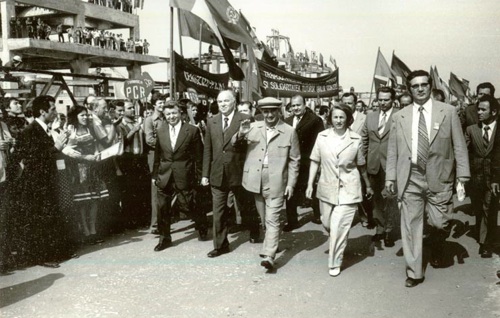
I think I owe an extra explanation: the VISIT involved months and months of preparation of literally the entire town (300,000 people). The whole town will stop, people (like my parents) were forced to go to this large meeting in the biggest square in town. They were listening for hours “the Man” talking about things that no one cared or even understood – then every 5 minutes they were supposed to clap and scream things like: “Ceausescu – Romania”. Their bosses were next to them, so if they wouldn’t do this, they would get in trouble at work. “The Man” would also visit factories – he would get off the car along with 20 people walking behind him (all trying to look as short as they could – “The Man” was not very tall); along the sidewalk they had to have either kids or people “performing”. For instance, there were people dancing dressed in popular costumes while he was just walking by, and ignoring everybody.
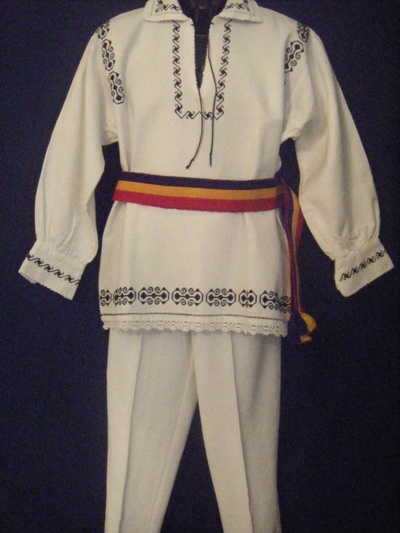
So now that you understand that a VISIT is an important event and needs to be organized, let’s get back to the kick-off meeting at school. That year, our school was tasked to provide “dancers”. You read it right. Dancers. Those dancers that I mentioned above. To get textbooks, so I can study, so I can perform well at the math Olympic games, I had to dance for “the Man”. At the time, I haven’t yet discovered my dancing skills, and I was told by everyone that I can’t dance, and I should stick to solving math problems. Do you understand my challenge? To get to solve math problems, I had first to dance. And not any dance. Romanian popular music dressed in a Romanian popular costume. Luckily, the school provided the outfit. Unluckily, they were from previous year, and they were not matching your size with the size of the outfit. They would just hand you an outfit. So, I got this large white pants, that my mother had to adjust so they don’t fall down when I dance in front of the “Man”. There were no pockets in those pants, nor in the jacket. As a consequence, the pocket money my parent gave me was in my shoe. I was planning on buying ice-cream with the money.
I thought initially that they would just hand us the suit, practice once, and then just do the dance in front of the “Man”. Obviously, I was wrong. I ended up spending months rehearsing a 30 second dance. It was this music teacher from some other school in town with an accordion who was playing the music and guiding us. He was gentle and accommodating. But, since this was a communist “sponsored” event, there was a guy from the communist party, in his forties, with a big belly and angry face who yelled at us continuously. Somehow, he thought that (1) he can teach us how to dance, and (2) that we dance better if he’s yelling at us.
Six months later, a few days after the fall of communism, I’ve seen the same guy buying the revolutionary newspapers, wearing the revolutionary outfit (a flag around the arm) and acting very revolutionary and anti-communist. It was the first time when I questioned whether there was a real change of government at the fall of the communism. But this is a different story.
So, I practiced for months, 2 steps to the left, 2 steps to the right, and then lift the left foot up, while holding hands of two unknown girls next to me. That was it. Even I could have done this dance.
At the V day, i.e. the Visit, we had to walk for an hour – the public transports were off, entire city was shut down, and the only way to go places was walking. I walked as I said for an hour to that place on the sidewalk where we were supposed to dance. And, like in the case of salami, I had to wait, and wait, and wait for hours until “the Man” shown up. We were all curious to see him in person – nobody really liked him – that was something that we would never have admitted in public – but as kids we were curious to see the Man with poems and the Man who was on TV all the time; the Man who put us through the salami experience. The Man, who in exchange for a dance, will give us textbooks.
All of a sudden, I am seeing a big crowd of people walking, with a guy with huge Soviet made camera running in front of the crowd, with a guy with huge headsets on (similar to the ones that everyone is using now – funny how certain things get in style) and a huge microphone so he’s not missing any word of wisdom from the Man.
Honestly, I have not seen the Man the first time he walked by. You remember all these months of practicing the dance? It all went away. I have no idea what steps we did, nor even if the accordion guy played anything at all. The angry big-belly yelling communist was not there – so we didn’t care what we did – we were trying all to get a glimpse of the Man. And I was successful in that, 10 minutes later, when the Man walked out of the factory. He looked short, old, tired and bored. I was very confused – how come this guy is screwing (sorry for the language but I have to get it out) an entire country, and I have to spend my summers either (1) waiting in line for salami or (2) dressed in large pants practicing a Romanian popular dance. This was September 1989, and in December 22, he was overthrown from power and the gates open for me to get out from that land.
After the Visit, I returned my large pants to school; my pocket money in my shoes were tear apart and lost it; So no ice-cream that time but I got my textbooks. What a joy – I can now solve more math problems!

Nicu is passionate about food, travel, wine, entrepreneurship and about helping people reach their potential.