Esther's Column: Before the law came mosquitos, lots of mosquitos
June 2016In 2008 I left the practice of law to live more creatively. This column explores my journey from prosecutor to artist.
I felt called to go to law school. It wasn’t a rational decision determined over time. I didn’t think about the nuts and bolts of getting there, how hard it may be, or the debt I’d inevitably accrue in pursuing three years of graduate education. I just knew that law was what I needed to study.
This deep knowing kept me focused on my end-goal when my parents said, “You’re doing WHAT?” It kept me grounded when my relative, a judge, said she wouldn’t recommend a legal career to anyone. And, it fueled my determination when my father said I didn’t have what it took emotionally to practice law because what was I going to do when a judge yelled at me in the courtroom, cry?
Ironically, this conversation induced an hour’s worth of tears and lead to years of bitterness over my father’s seemingly unsupportive attitude toward my chosen career path. However, looking back I realize that he was right. Long term, my personality was not suited to the highly competitive, verbally combative field of law. As an acquaintance once said of her divorce, “Getting married was the right thing to do, and getting divorced was the right thing to do.” I feel the exact same way about my legal career.
With the decision made, I had to actually get into law school, which was not an overnight task. It was February 1993. My temporary job in Alabama was ending and my new temporary job with the National Park Service was beginning. In March, I packed up my Volkswagen Fox and drove northeast to Assateague Island National Seashore in Berlin, Maryland. I’d accepted a position as a biological technician responsible for monitoring the island’s mosquito population for Eastern Equine Encephalitis (EEE), a potentially fatal viral disease spread by mosquitos that bit infected birds and thereafter horses and sometimes humans.
This position required me to capture, identify, and count thousands of living mosquitos. How does one go about capturing mosquitos alive? Very carefully. Once a week I donned a head net (not a fashion statement) and hiked to remote areas to set mosquito traps.
The trap had a main netted compartment with side pockets that held cotton balls saturated in sugar water to attract the insects. It had a small light, also an attractor, and a fan that pulled the mosquitos into the net. Once they were captured they could not escape. I returned at dawn to collect the traps filled, sometimes six inches deep, with mosquitos.
The mosquitos were stunned in the freezer to immobilize them while I and a fellow technician identified their genus/species and estimated the number caught. After staring at hundreds of mosquitos I became quite skilled at identifying them easily, although that knowledge has since left my brain. I’m OK with that. Finally, I gathered a small sample from each trap and sent them to Yale on dry ice for EEE blood testing.
From March through September 1993 none of the mosquitos tested were positive for EEE, for which I was grateful. I had sustained innumerable bites through my clothing while hanging and collecting traps at dusk and dawn - prime feeding times for mosquitos. However I heard after I left that a pony died of EEE in October of that year.
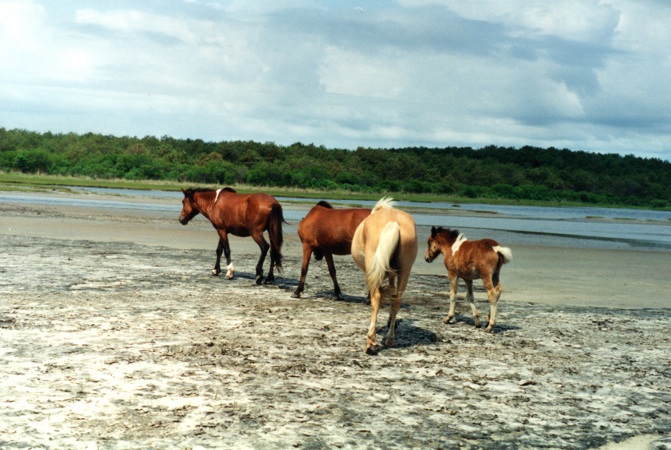
At Assateague, I also helped with other responsibilities like bay water monitoring, i.e., driving around in a boat with a coworker and collecting water samples at prearranged testing sites; litter surveys, i.e., beach cleaning with a data collection component; Assateague Island pony monitoring, i.e., whacking through the brush to find ponies and sketch their markings for later identification; piping plover monitoring, i.e., posting signs and fences to protect endangered piping plover nesting sites; and salt grass surveys, i.e., marking off a quadrant and counting every single strand of grass. And I left all this to go to law school? Yes I did.

After eleven years as a state prosecutor in New England, Esther retired from the practice of law at 38 years old to live more creatively. In 2011 she was introduced to the Zentangle (R) method of pattern drawing, which ignited a passion for drawing that had been ever present, but rarely nurtured. She is now a Certified Zentangle Teacher and practicing artist in Duluth, Minnesota where she gets paid to teach others how to draw pretty lines. Her husband Paul and cat Haley support her on this continuing journey called life.