Nicu and Kathleen’s Healthy Cozonac
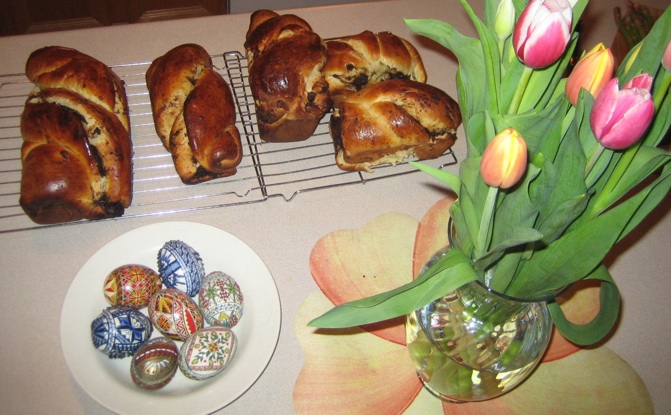
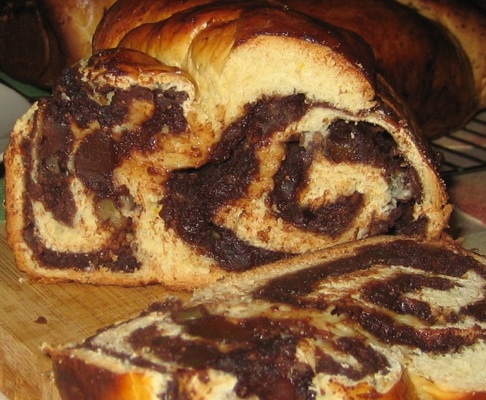
March 2016Easter is one of the most important and festive holidays in Romania. Every spring, my partner Nicu and I look forward to making our own healthier versions of the traditional Romanian Easter foods: stuffed peppers and grape leaves, red eggs (dyed naturally with onion skins), fish, and the highlight: the traditional Romanian Easter bread cozonac - layered with sweet orange zest and braided with a chocolate, fruit and nut filling.
Nicu’s mother gave us her traditional butter and egg yolk rich recipe over Skype from Romania. However, we have adapted this to our healthier lifestyle in Boston, making it vegan and sugar free. Every year, we play with the ingredients and make it a bit differently. It is always delicious. This year we utilized fiber rich chia seeds and whole wheat flour. We spend all Saturday cooking, and then attend a beautiful candlelight midnight mass at a Russian Orthodox Church. Then, we come home to break the fast and celebrate by eating the delicious bread. We hope you enjoy our recipe. Don’t worry about being too precise. Experiment with adding your own favorite dried fruits, nuts and seeds. Maybe it will inspire you to play with healthier versions of your own traditional holiday recipes.
Nicu and Kathleen’s Healthy Cozonac
Makes approximately four medium sized loaves
Active Time: 1 hour
Total Time: 3 hours (including 1 hour for dough to rise)
Dough:
- 2lb. bag of organic whole wheat pastry flour
- 1/3 cup organic chia seeds
- 1 cup organic unsweetened soy milk
- 2 packets (¼ oz. each) of active dry yeast
- 3 tbsp grated organic orange rind
- 3 tbsp pure vanilla extract
- 1 tbsp coconut oil (for greasing loaf pans)
Chocolate filling:
- 1/3 cup chia seeds mixed with unsweetened soy milk (left over from dough mixture)
- ½ cup unsweetened organic baking cocoa
- ½ cup organic raisins
- ½ cup organic dried figs
- ¾ cup organic pitted deglet dates
- ½ cup organic dried Turkish apricots
- 1 cup raw walnuts
- ¾ cup raw pecans
- Note: you may use any dried fruits or nuts of your choice
- 2 tbsp pure vanilla extract
- 3 tbsp organic orange rind
- juice squeezed from half an orange
- Extra dried fruits and nuts for rolling into braid
Directions:
- Pour a 2lb. bag of flour on clean surface for kneading or bread board. Make a reservoir or hole in the middle of your flour volcano (Note: this is the old fashioned way of making the dough. For those of you who are more modern, you may opt to mix in a bowl, or even use a professional stand mixer)
- Add 2 yeast packets to about 2 cups warm water (about 110 degrees) in a small glass pitcher. Leave mixture for a few minutes to activate yeast.
- Mix chia seeds with unsweetened soy milk in a bowl. Let mixture sit for about 5 minutes, or until chia seeds become gelatinous. This will serve as an egg replacement.
- Grate organic orange rind into flour reservoir with microplane or other grating tool.
- Once yeast is activated, it will form a frothy head. Gently pour a little in the hole, mix flour into yeast with hands. Add a little more. Mix together with hands. Repeat, until all of yeast mixture is incorporated into dough.
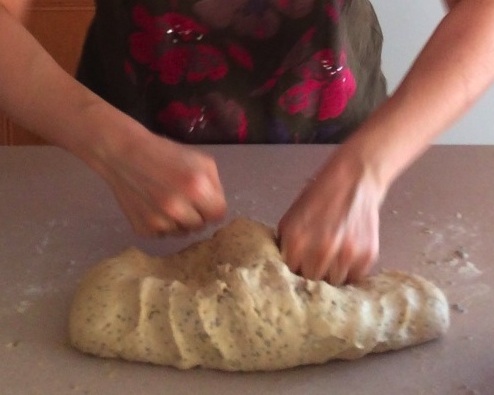
- Create hole again in center of dough. Pour small amount of chia soy milk mixture and vanilla extract slowly into hole. Knead dough, and punch down for several minutes, until dough is not sticky. Repeat until about 2/3 of chia mixture is used, reserving 1/3 cup of this for filling.
- Become one with the bread dough. Use your intuition, and feel the texture of the dough in your fingers to gauge its moistness and texture. Add a spoonful of extra flour if the dough seems too wet. Add a spoonful of extra chia liquid if dough is too dry. This may take up to 10 minutes or so of kneading, consequent punching down of the dough, and kneading again. You will know the dough is ready once it has a moist elastic texture, but no longer sticks to the table or surface.
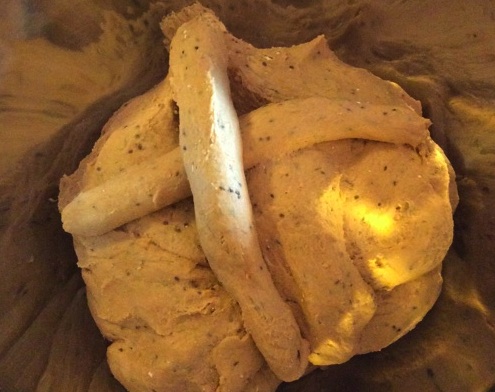
- Put mound of dough in bowl. Take 2 small bits of dough, form into rolls, shape in the sign of a cross and place on top. This is a traditional Romanian Easter tradition. Keep bowl in a warm area, and allow to rise for one hour.
- We will now make the chocolate filling. In a food processor, add reserved chia soy milk mixture, cocoa powder, dried fruits, nuts, vanilla, orange rind, and orange juice. Blend until mixture is a smooth spread, but still has some small chunks remaining. Place aside in a safe place, as this spread is very tempting.
- Preheat oven to 400 degrees.
- Once dough has risen to about two times its original size, take small handful of dough, place on lightly floured surface, roll into ball, and flatten with a rolling pin.
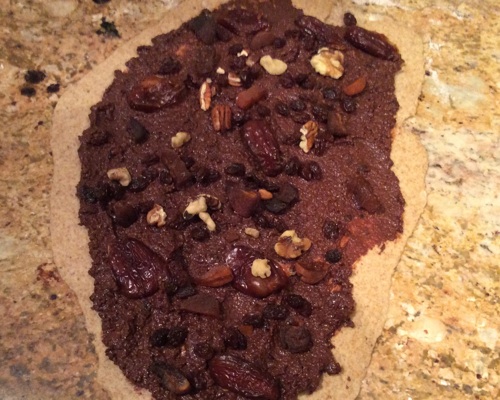
- Spread the delicious chocolate filling onto the flattened dough round. Feel free to add extra fruits and nuts to the top, like a sweet pizza.
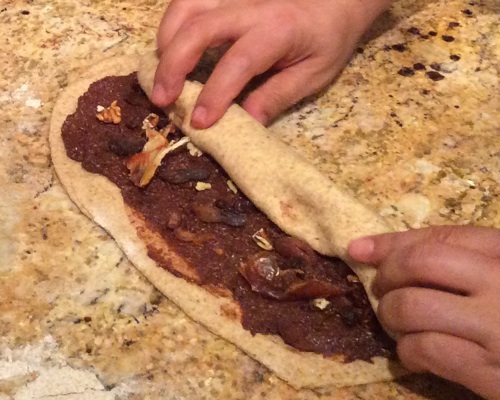
- Roll up pizza into long snake shape.
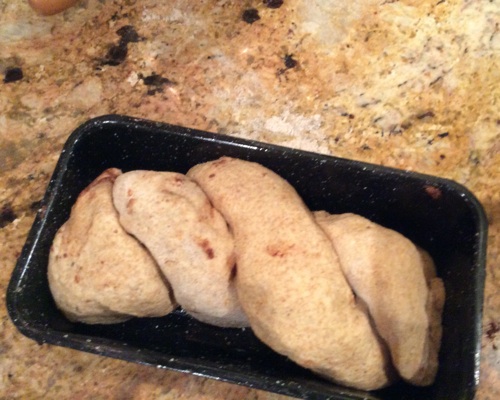
- Repeat process. Take 2 rolls, braid together, and push into loaf pan greased with coconut oil. Repeat process until you have used up all the dough and chocolate spread.
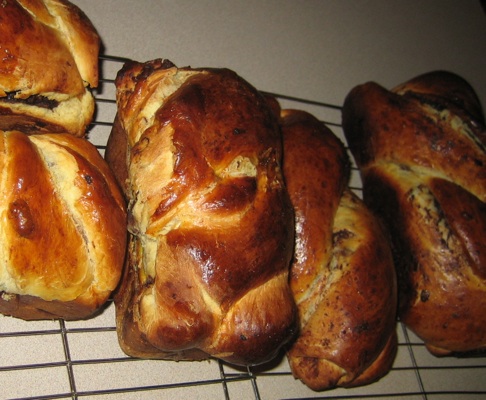
- Bake at 400 degrees for about 45 minutes. When you take it out, turn upside down, and knock on the bottom of the loaf. You should hear a hollow echo.
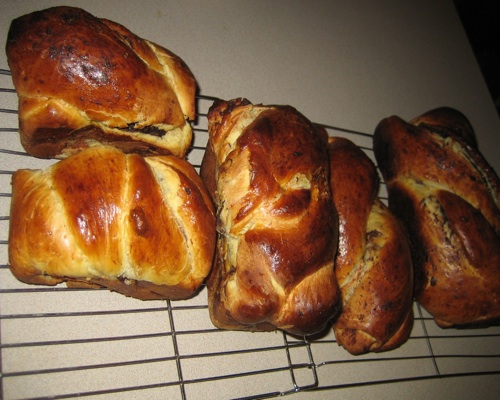
- Turn over loaf pans onto drying rack, and let cool.
First, you need to get the flour ready (steps 1,2,3,4 above)
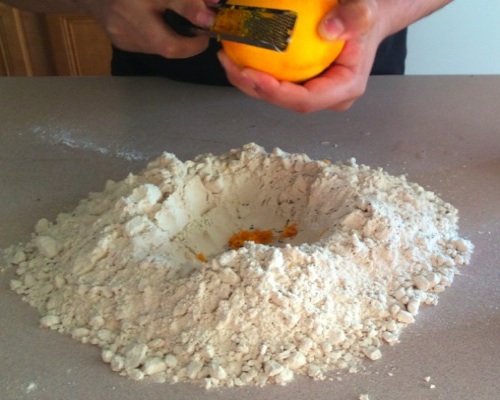
While you do this, don't be afraid to use your hands (steps 5,6 below)
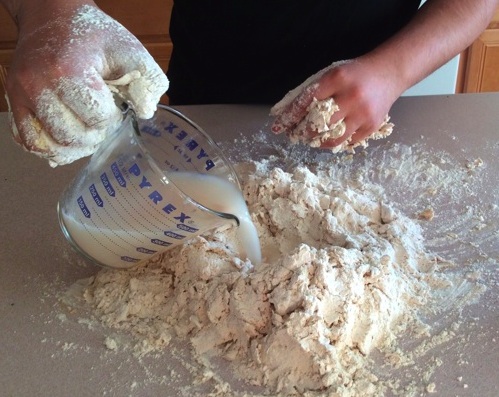
You'll become one with the dough (step 7)
The cross helps it rise (step 8)
Make a chocolate, fruit and nut pizza. (steps 11,12)
Roll it up. Repeat. And don't eat. Yet. (step 13)
Braid two rolls. Squeeze it in a greased pan. Bake in oven. Who greased your pan?
Cool on racks. It's cool. But most importantly tasty. Don't taste it yet. Go to the church first!
Enjoy a slice after the midnight Easter mass, to break the fast!
“Hristos a înviat!” “Adevărat a înviat!” (This is a traditional Romanian greeting, used instead of hello during Easter time. Translation: “Christ is risen!” “Indeed, he is risen!”)
Experiment #1! Easter 2014. Made with whole wheat flour. It didn't blow up. But we ate it!

Experiment #2. Easter 2015. Made with chia seeds. No seeds left behind.

And now, enjoy a taste of a traditional Orthodox Easter ceremony...
The Holy Trinity Orthodox Cathedral, on Park St., in Boston, was completely dark inside, except for a thin beeswax candle before each choir member, as they rejoiced in Easter hymns from an ancient time. As our eyes adjusted, we could begin to see the shadowed outlines of the beautiful icons surrounding us, as well as men, women and children, kneeling and touching their heads to the ground before them. The air was thick with the incense of frankincense and myrrh. We bowed our heads to receive this special fragrant blessing. The cross was in silhouette above the altar stage, with a majestic golden icon of Mother Mary and child on the left and a bejeweled Russian painting of the heavenly father on the right.
The priest emerged from the left door, in a white brocade robe with golden embroidery sash, holding a tall candle. He sang in a very low Byzantine voice, “Come, and take the light.”
He lit the candles of the silk brocaded monks and attendants nearby, who shared the light with each person next to them. Suddenly, in domino effect, the church was aglow with light, love, and happiness. An elderly man next to me shared his candle flame to light mine, revealing his soft smile. We could now see the beautiful icons of the saints illuminated all around us, protecting us. The church bells rang loudly and continuously from above, ding dong, ding dong, ding dong!
Everyone followed the priest and his assistants, holding golden staffs and painted icons, as they sang “Christ is risen from the dead, Trampling down death by death, And upon those in the tombs, Bestowing life!” We walked a full circle around the church with our candles, sometimes stopping to allow a stranger to relight them, as the small plastic cup encircling them did not protect them from the windy breeze. Once everyone had gathered back at the church door, the priest exclaimed “Christ is risen!” The people replied “Indeed, he is risen!” He repeated this in Greek, Russian, French, Serbian, and some other Eastern European languages. “Hristos a înviat!” he shouted in Romanian. “Adevărat a înviat!” we yelled back.


Kathleen is passionate about food, travel, wellbeing and helping people create meaningful livelihoods.